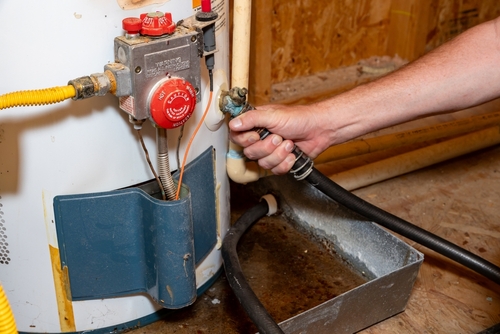


Your water heater is the hardest-working appliance in your Hemet home, and it is also the one most people ignore until something goes wrong. In a region with water as hard as what comes through Hemet’s municipal supply, “something going wrong” happens faster than most homeowners expect.
The average tank water heater lasts eight to twelve years under normal conditions. In Hemet, where mineral-heavy water accelerates sediment buildup and corrosion, many units start showing problems closer to the seven or eight year mark — especially if they have never been flushed.
The Warning Signs Most Homeowners Miss
Water heater failure rarely happens all at once. The unit gives warning signs for weeks or months before a catastrophic leak or complete loss of hot water. Recognizing these signals early gives you time to repair or replace the unit on your schedule — instead of in a panic.
If your hot water runs out faster than it used to, sediment has likely built up on the bottom of the tank, reducing the effective volume of water the burner can heat. If you hear popping, rumbling, or crackling sounds during heating cycles, that is steam escaping through compacted sediment — a clear sign the buildup is significant. If the water coming from your hot tap has a rusty or metallic tint, the anode rod inside the tank may be depleted and the tank itself may be corroding. For a deeper look at these patterns, see our guide to common signs your water heater needs repair.
Water pooling at the base of the unit is the most urgent sign. Even a small puddle can indicate a crack in the tank, a failing pressure relief valve, or a corroded fitting. A slow tank leak in a garage or utility closet can go unnoticed for days, causing significant water damage to floors, walls, and stored belongings. If you spot any moisture around your water heater, do not wait — this is a same-day repair situation.
Why Hemet’s Hard Water Is Tough on Water Heaters
Hemet’s water supply carries high mineral content, particularly calcium carbonate. When water is heated inside the tank, these dissolved minerals fall out of suspension and settle as sediment on the bottom. Over months and years, the sediment layer thickens and hardens.
In gas water heaters, the sediment insulates the tank bottom from the burner flame. The unit runs longer and hotter trying to heat the water, which increases energy costs and overheats the steel at the base of the tank. That thermal stress accelerates corrosion and dramatically shortens the unit’s lifespan.
In electric water heaters, sediment buries the lower heating element. The element overheats, burns out prematurely, and the unit loses half its heating capacity. If your electric water heater produces lukewarm water even at its highest setting, a buried heating element is the most likely cause.
Annual flushing removes loose sediment before it hardens. But once the sediment calcifies into a solid layer — which happens faster in Hemet’s hard water than in softer water regions — flushing alone will not remove it. At that point, you are looking at either a professional water heater service call to assess salvageability, or a replacement.
Repair vs. Replacement: Making the Right Call
Not every water heater problem means you need a new unit. A faulty thermostat, a worn-out heating element, or a leaking pressure relief valve are all repairable components that cost a fraction of a full replacement. If your unit is under eight years old and the tank itself is not leaking, repair is usually the better investment.
Replacement makes more sense when the tank is leaking from the bottom (this indicates internal corrosion and is not repairable), the unit is more than ten years old and experiencing multiple issues, repair costs exceed 50 percent of the cost of a new unit, or you are consistently running out of hot water because the tank size no longer meets your household’s needs.
If you are not sure where your unit stands, our team can evaluate it and give you a straightforward recommendation. We do not push replacements when a repair will solve the problem — and we will not band-aid a failing unit that needs to be replaced. You can read more about what to check first when your water heater stops working.
Choosing the Right Water Heater for Hemet
If replacement is the right move, the two main options are a traditional tank water heater and a tankless (on-demand) unit. Both work in Hemet, but there are trade-offs.
Tank water heaters are less expensive upfront and simpler to install, but they are more vulnerable to sediment buildup in hard water areas. Tankless units heat water on demand and are not affected by sediment in the same way — but they are sensitive to scale buildup on the heat exchanger, which also requires periodic maintenance in hard water environments.
The California Energy Commission’s appliance efficiency standards have tightened in recent years, so any new unit you install will be significantly more efficient than what it replaces. Your plumber can walk you through the options based on your household size, water usage, and budget.
Local Water Heater Service for Hemet Homeowners
The Amazing Plumber serves Hemet and the surrounding San Jacinto Valley including San Jacinto, Sun City, and Winchester. If your water heater is showing any of the warning signs above — or if you just want a professional to evaluate a unit that has been in service for a while — we can inspect it and give you a clear picture of its condition.
If you are also dealing with hard water damage to your drains or fixtures, take a look at our posts on drain cleaning in San Jacinto and stubborn drain clogs caused by hard water in Hemet. Hard water affects your entire plumbing system, and addressing it holistically — not just one fixture at a time — saves you money in the long run.
Call (951) 287-9692 to schedule water heater repair or evaluation in Hemet, CA.